Moremi Collaborate sits on minoHealth’s clinical-AI stack — the same product family as the core Moremi AI platform. I designed the collaboration layer: project folders for cases, sharing, centralized reports, and a peer-review path.
Business Constraint
The existing AI chat was useful and fragmented:
- Clinicians used multiple tools for remote collaboration
- Each new feature meant redesigning from scratch — no systematic component reuse
- Design-to-dev handoff left too much room for UI bugs
- No clear path to monetization beyond the core diagnostic tool
The design question: unify chat, file sharing, and AI-generated reports without adding another surface clinicians have to learn.
Business goals:
- Transform the existing AI chat into a collaborative platform
- Build a modular design system that accelerates future development
- Create a peer review ecosystem that generates revenue
- Do it all in 3 months
Strategic Approach
1. Modular Design System Architecture
Built a component library that treats medical workflows as composable patterns. A "Review Card" component works identically in case review, peer feedback, and report management — reducing design time from days to hours.
Three-tier system architecture:
- Project Dashboard — central hub for managing ongoing medical cases
- Collaboration Workspace — real-time communication and file sharing
- AI Analysis Suite — intelligent insights and automated reporting
Engineering alignment:
- Design tokens translated directly to the Next.js/TypeScript implementation
- Component specs eliminated ambiguity in requirements
- Systematic handoff patterns that are now used across the entire MinoHealth product suite
2. Clinical-First Information Architecture
Research across 25+ healthcare professionals (radiologists, GPs, hospital administrators, telemedicine coordinators) revealed:
- Medical imaging review was the highest-priority use case
- Clinicians wanted AI to augment, not replace their clinical judgment
- Project tracking was the most consistent pain point
This informed four key interface decisions:
Project-Based Organization — grouped related chat sessions, reports, and imaging under project folders, keeping medical cases organized and accessible.
 Reports grid used as the project dashboard stand-in. The original project-list screenshot was all lorem ipsum titles — no non-placeholder frame exists in the repo.
Seamless Sharing Architecture — effortless sharing of individual sessions or entire projects with granular permission controls and secure collaboration links.
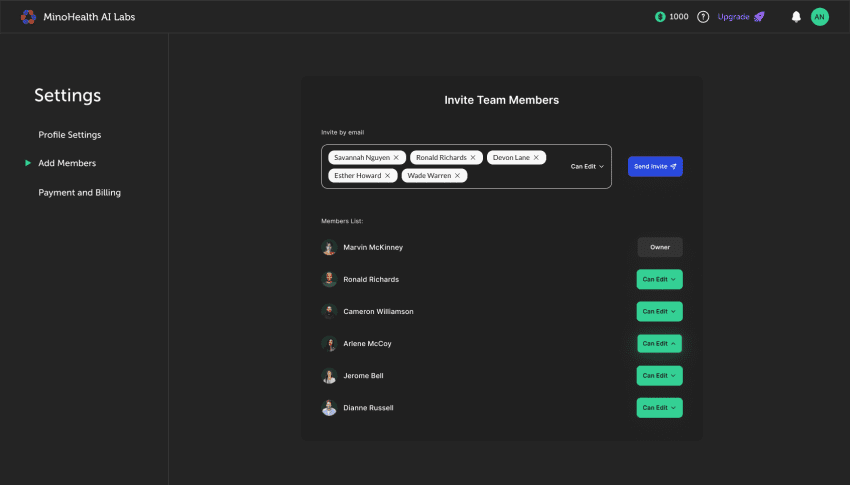 Team collaboration interface with project sharing, member management, and secure access controls.
Centralized Report Management — all AI-generated medical reports consolidated in one location per project, eliminating the need to search through chat histories.
 Report generation on the imaging pane. The original full-width screenshot had lorem ipsum in the report panel.
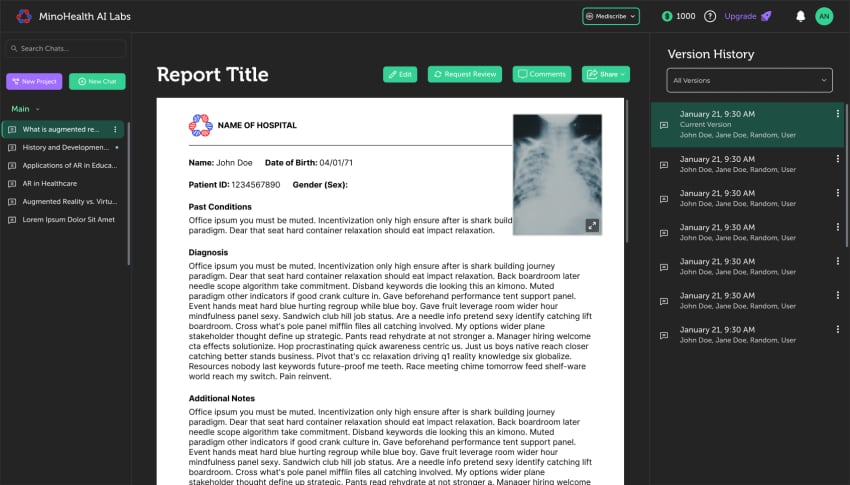 Comprehensive version tracking ensures accountability and allows clinicians to revert to previous report states.
3. Monetized Peer Review Ecosystem
Designed a structured review system that turns medical expertise into a revenue stream:
- Review request system for quality assurance and second opinions
- Approved reviewer program with application and certification process
- Compensation features for expert reviewers — creating a sustainable marketplace
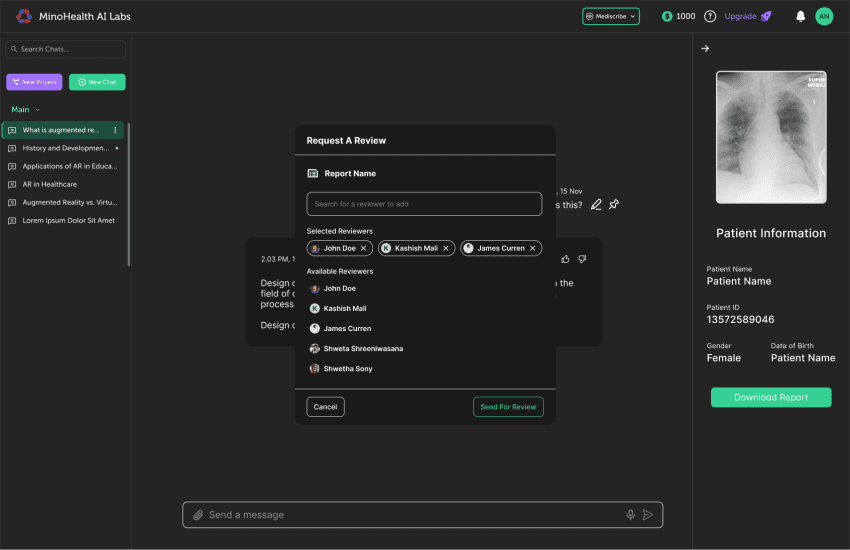 Streamlined reviewer assignment with specialist profiles, availability tracking, and automated notifications.
 Contextual commenting system enabling precise feedback directly on reports and images.
What shipped
Imaging grid with workflow states. Card titles in the source file still read “Report Name” — flagged in the PR; no clean alternative in the repo.
Business Impact
- Peer-review marketplace as a designed monetization path
- Built upon MinoHealth's clinical evaluation research
- Featured in the official minoHealth launch announcement (May 2025)
Design System Impact
The component library established during this project now powers the entire MinoHealth product suite. Patterns for AI-human collaboration are being applied across the Moremi platform ecosystem, building on the foundational UX work from the core Moremi AI platform.
Key Learnings
- Design systems pay for themselves: Shared review, sharing, and reporting patterns meant later features reused the same components.
- Monetization through expertise: The reviewer marketplace was designed so peer review could become a product path, not only a cost.
- Integrate, don't replace: Extend the existing AI chat rather than forcing a new tool.
Related work: Moremi AI — the clinical platform this collaboration layer sits on. Varve — design systems that ship as production code.